
Dearest reader,
This post isn’t about what happened the day of William C. Quantrill’s Civil War massacre in Lawrence, Kansas, Aug. 21, 1863.
I won’t determine whether it was Lawrence’s own poor preparation that left the anti-slavery town open to attack or whether is was personal revenge seething in Quantrill’s pro-Confederate guerillas’ hearts that brought the killing of 150 to 180 men and boys in Lawrence. Nor will I get bogged down in rebel Lost Causers’ defense of their treason or determine the worth of Kansas’s retaliatory General Order No. 11, pegged either as an atrocity against innocent Missourians or as a meritorious necessity to smoke out Quantrill’s roughly 400 murderous bushwhackers and thieves. All of that and more await you in books, articles, papers, websites, speeches, podcasts, bits of it here, here, here.
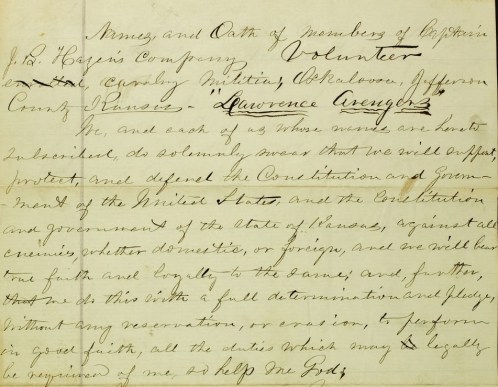
Instead, I’ll take you 20 miles north across the Kansas River to Jerome Napoleon Bonaparte Hazen in Oskaloosa, Jefferson County, Kansas, for an illustration of the state’s response to Quantrill’s Raid.
Within three days of the massacre, J.B. Hazen had organized an Oskaloosa militia company called the “Lawrence Avengers” under the statewide order to activate Kansas militias. A good share of the men on the Avengers’ early roster, including Hazen, had been radical freestaters who had fought, scouted and voted to make Kansas a state free of slavery during the turbulent Kansas territorial years. That was just a few years before Kansas gained statehood and the Civil War began in 1861.

News of William C. Quantrill’s early morning assault on the people of Lawrence had tumbled across the prairie to incredulous neighbors in Oskaloosa and nearby Kansas towns. Some could see the smoke over Lawrence. Unthinkable rumors fluttered in.
But they didn’t yet have the whole story of Quantrill’s guerrilla’s slaughter of about 180[1] men, boys and army recruits. The next day, a few newspapers carried haunting snippets about the massacre at Lawrence, the state’s center for anti-slavery partisans since Kansas was opened to settlement in 1854.
John W. Roberts[2] , the publisher of The Independent in Oskaloosa, decided to go with the little information he had for his weekly newspaper the next day, Saturday, August 22. His headline was “Lawrence Burnt.” (See clipping)
After another day, Kansas daily newspaper columns poured out details of atrocities, street by street, house by house, corpse by corpse, in Lawrence. Outraged calls for punitive violence against Quantrill and his Bushwhackers screamed through Kansas, whose Union soldiers were fighting near and far in the Civil War.

The state of Kansas responded. Kansas Gov. Thomas Carney quickly fired off General Order No. 1 calling the state’s home militia into active service to protect Kansas from what citizens feared would be future Quantrill-like invasions and murders in the state.
J.B. Hazen, Oskaloosa, had already fought in the Civil War, joining one of U.S. Sen. James H. Lane‘s own brigades, the 5th Reg., Kansas Cavalry,[3] and serving from July 1861 until March 23, 1862.[4] He was discharged for an injury and left the service a corporal at age 25. Before Kansas was a state, Hazen was in Jesse Newell’s Rifle Company in 1859, helping escort Underground Railroad conductor John Doy’s rescue squad back into Kansas. You also might recognize Mr. Hazen from his 1867 wagon train journal about his overland trip to California, detailed in this blog.
After Quantrill’s raid, Hazen was early to put together an Oskaloosa cavalry for the state militia, responding to Kansas Gov. Thomas Carney’s militia call for men aged 21-45 not in regular military service to enroll to protect their towns and homes “… from murder and rapine.”[5]
In fact, The Leavenworth Times reported that Hazen’s “Lawrence Avengers” was the second company in Kansas to report his roll after the governor called upon the militia after the Lawrence attack. Calling Hazen one of the ’56 boys (1856) for his fighting for the freestate cause during the Bleeding Kansas struggles over slavery, the Times described Hazen’s acceptance of a “Lawrence Avengers” militia flag with its gold lettering and stars stars. (Read the newspaper clipping here.)
Young Carrie Macomber, who had two brothers in Kansas regiments, gave the townswomen’s flag to Hazen with a short speech. Hazen likewise addressed onlookers.

“Union,” the Times correspondent for Oskaloosa, wrote several anonymous Oskaloosa regiment articles during the war. Oddly, the article about the Avengers appears in a Leavenworth newspaper and nothing of the article’s jaunty description and background was shown in the hometown Oskaloosa paper, The Independent. The full roster of the original “Lawrence Avengers” is at the bottom of this post.
Throughout Jefferson County and the state, militia groups coalesced precinct by precinct. Gov. Carney’s order activated Civil War militia organizations that already existed. Men 21 to 45 years old who were not yet enrolled were ordered to enroll, if they were not in the regular army. These smaller precinct-level militias were combined and combined again to form larger county and multi-county state militia regiments. As Hazen’s crew was combined with other Jefferson County militia organizations, it lost its “Lawrence Avengers” name. The regiments, including some Jackson County sections, were under command of Col. Azel W. Spalding.
In Osawkee (now Ozawkie), Jefferson County’s proslavery headquarters during pre-statehood days, old freestater Ephraim Bainter organized “Bainter’s Rangers” on Aug. 31, 1861. Included on its roster was Valentine F. Newell, Jesse Newell’s oldest son. The “Jefferson Rangers” formed in Sautrell/Sautrelle Falls [6] on Sept. 5, 1863.
The militia regiments, their rosters filled and their officers elected, were required to conduct weekly drills and to be ready to defend Kansas, within Kansas. As they drilled, Kansans clamoured for vigorous retaliation against Quantrill’s guerillas and Bushwhackers, who they feared would strike again.
In the regular army, Brig. Gen. Thomas Ewing doomed key Missouri counties on the Kansas border with General Order No. 11 warning the nation that his troops would soon leave no place for Bushwhackers and guerillas to hide inside the Missouri border. Residents in four Missouri counties had just 15 days to leave. The Union Army burned homes and farms, leaving little or nothing for Missourians to return to. It was an action loudly applauded in Kansas but is said to have turned more Missourians, including Union-supporting Missourians, against the Union. Go to Missouri today and you will find General Order No. 11 well remembered on the border.
Besides the order to eliminate cover for pro-Confederate guerillas, army recruiters took to the road to fill the Kansas ranks with more soldiers. Charles R. “Doc” Jennison, leader of “Jennison’s Jayhawkers”(the 7th Kansas Volunteer Cavalry) campaigned to rid the earth of Confederate guerrillas and their attacks on Kansas civilians and troops.
Sen. James H. Lane addressed a crowd in Leavenworth six days after the massacre in Lawrence, charging that the confederate guerrillas hiding in the Missouri border counties could be stopped only one way.
“I will tell you what I want to see,” Lane was quoted as saying, in the Aug. 28 Leavenworth Times, and outlining the policy of General Order No. 11. “I want to see every foot of ground in Jackson, Cass and Bates counties burned over — everything laid waste. Then we shall have no further trouble. The bushwhackers cannot then remain in the country, for they will have nobody to feed them — nobody to harbor them — nobody to provide them with transportation — no place to sleep in, and will have thirty-five miles further to march before they reach Kansas.”
Regiments like Jennison’s had used 1850s Kansas-Missouri border war tactics in Missouri, scouting and harassing enemies, stealing horses, liberating enslaved people. And while these “Jayhawker” methods were criticized and shamed before and again after the war, the methods were exactly what Kansans called for for after Quantrill’s Raid.
John W. Roberts, editor of The Independent in Oskaloosa, lauded Ewing’s General Order No. 11 and suggested that the Lawrence tragedy might have been prevented if Ewing had issued such an order before the Lawrence massacre and if Jennison had already raised his new regiment.

Jennison and George H. Hoyt, later a lieutenant colonel for this unit, barnstormed Eastern Kansas recruiting the 15th Regiment Kansas Volunteer Cavalry. Jennison’s newspaper ads screamed: “No compromise with Rebels! — No quarter to Bushwhackers! Desolation Shall Follow Treason Wherever this Regiment Marches!” The ad promised rifles, revolvers and sabres for the regiment.
Jennison and Hoyt, or at least Hoyt, brought their post-Quantrill’s Raid “Death to Traitors” recruiting campaign to Oskaloosa. The Oskaloosa newspaper’s observation about the speech in its Sept. 15, 1863, edition, said that Captain Hoyt had said many good things in his speech. But.
“… we protest against the useless amount of profanity which characterizes too much of the public speaking of politicians in Kansas,” the brief article said. “The English language is strong enough to give expression to any idea proper to be uttered without the use of profanity or vulgarity. We hope there will be a reform in this particular.”
One young recruit, Jesse Newell’s 18-year-old son Mitchell “Doc” Newell, had joined up a couple of months before Quantrills massacre. He was sent off with other Oskaloosa recruits (5th Kansas Cavalry) to fight the pro-confederate guerillas on the Missouri-Kansas border. Michell’s older brother Robert had been killed in 1861 in the Battle of Wilson’s Creek in Missouri. Another brother, Abram, was injured in the same battle.
Mitchell Newell, whose company in the 5th Kansas was combined in the Jennison’s new 15th, survived. In one of the many reminiscences of the Civil War, an anonymous author “Jayhawker” wrote a series of newspaper columns about his experiences in the 5th and the 15th, taking note of young Mitchell.
In one of the many war-time reminiscence stories published after the war, a writer described going on a mission in the Missouri woods with members of the young Newell’s 15th Kansas Cavalry and Capt. Charles F. Coleman of the 9th Kansas Cavalry. “Jayhawker” admired the stealthy skill of Coleman, who like a deer hunter hid like the Bushwhackers did in the thickets in the woods, waiting for his chance at a bevy of Quantrill’s Raiders.

This clip is from an article written anonymously by “Jayhawker” and published in the American Nonconformist newspaper, Thursday, April 11, 1889. Image from newspapers.com. The article, entitled “War on the Border” By “Jayhawker.” “Chapter III” may be read on the newspapers.com website here.[1] The number of dead has been reported variously from 150 to 200, but many accounts put the number in the 180 range.
[2] John W. Roberts was editor and publisher of his weekly, The Independent (renamed The Oskaloosa Independent), from July 1860 into 1892, although Roberts did not move from Ohio to Kansas until 1862.
[3] The 5th Kansas Cavalry was a unit set up by U.S. Sen. James H. Lane when President Abraham Lincoln gave him the extraordinary designation of brigadier general in 1861, meaning Lane could vault over normal procedure and raise troops himself. Lane’s 3rd and 4th regiments, along with the 5th Kansas Cavalry, were called Lane’s Brigade. Lane’s securing such power caused consternation for Kansas Gov. Charles Robinson, who held the duty of organizing the state’s military units, and his supporters. Washington powers were well aware of Lane’s strong ties to his Kansas men, many from territorial days, and the recruiting power he would have. More: http://www.civilwaronthewesternborder.org/encyclopedia/lane-james-henry
[4] From the Report of the Adjutant General of the State of Kansas, 1861-’65. Vol. I Volume 1, pt. 1-2 – Primary Source Edition, p. 138.
[5] Quoted text is taken from General Order No. 1 as it was published in Kansas newspapers. https://www.newspapers.com/clip/22868830/gov_carneys_general_order_no_1/
[6] Sautrell or Sautrelle Falls had replaced Grasshopper Falls as the the name of this Jefferson County town. “Sauterelle” is the French word for grasshopper so the town apparently didn’t go far enough with its image makeover, and the town is now Valley Falls.
The Kansas State Historical Society has digitized the handwritten county militia records from the Civil War on its Kansas Memory website. This link takes readers to the beginning of the Jefferson County portion of page, Kansas Memory Item 227858, page 910.
The pages below show a post-Quantrill’s raid state militia organization in Oskaloosa, Kansas, the Lawrence Avengers, organized Aug. 24, 1863, by J.B. Hazen. The page may be viewed on the Kansas State Historical Society’s Kansas Memory images, Item 227858, page 940, here.


