An Underground Railroad Ambush in Jefferson County, Part VII. A Glorious Return: Captain Jesse Newell and His Rifle Company

A sentence in James B. Abbott’s “how we did it” John Doy  rescue story offers another insight into our Oskaloosa freestater Jesse Newell.

We pick up our story at Rev. Josiah B. McAfee’s place at Grasshopper Falls (now Valley Falls), where John Doy and his rescuers and John Doy had been fed and had a rest. Worried that his crew was being tailed by enemies, Abbott called for Jesse Newell’s aid in the final 20-mile leg of the journey from the St. Joseph jail to Lawrence.[1]

“…word was sent to Captain Jesse Newell, of Oskaloosa, to furnish an escort; and when we arrived at his place we found the Captain on hand with the following-named officers of his rifle company, to wit: Jerome Hazen, First Lieutenant; J. I. Forbes, Second Lieutenant; John Newell, Gil. Towner, Robert Newell, James Monroe, Resolve Fuller, M. R. Dutton – privates; and eight or ten others. And without delay we passed on, most of the escort going to within a few miles of Lawrence, and the captain and a few of his men going the whole distance, where we arrived about six o’clock in the evening, and where we also found the streets lined with people…,” Abbott wrote of the glorious Lawrence arrival in July 1859.[2]

Learning that Jesse Newell had assisted out his fellow abolitionists this way was helpful to my research on Newell. But that first sentence was alluring, the part that called Jesse Newell “Captain” and that he had a “rifle company.” What was he doing with something called a rifle company in 1859 and what did it mean that he was captain of it? I don’t have an oath-worthy answer for that but believe the reference points to a free-state militia type group for defense against proslavers and working to ensure Kansas would become a free state, or it could be the beginnings of a Jayhawker group.

No tidy, primary source that I’ve ever seen says that Jesse Newell was a Jayhawker, and I mean “Jayhawker”[3] in the sense of settlers who took action for the free-state and subsequent Civil War Union cause. Characters like Jesse Newell challenge us to divine answers from a lot of wobbly sources.  But these anecdotes and aged after-the-fact tales are what we’ve got. I’ve pulled up a few today to help you get to know something of Jesse Newell, who lived from 1812-1881. You’ll see more of these anecdotes in future posts.

Story No. 1: Jayhawkers and Uncle Jesse Newell

Jeremiah H. Bennet, who settled near Grasshopper Falls in 1857, wrote a series of articles, Early Recollections of Kansas, for The Oskaloosa Independent in 1878. Bennet was a lawyer, a county schools official, and a knowledgeable and entertaining writer.  His May 11, 1878, Recollection reveals Oskaloosa and  Jefferson County  Jayhawker activity during the Civil War, the “rebellion,” as Bennet calls it. Warning: Bennet’s first paragraph set-up speeds through about a dozen things that are separate tales in themselves, but we will zero in on the Jayhawkers.

“It was in the dark portion of the rebellion. Close to the time when the southern army held possession of the Hannibal & St. Joe Railroad; when a Rebel paper at the city of Atchison rejoiced at the Union defeat at the battle of Wilson’s Creek; when the Jayhawkers held high carnival at Oskaloosa; when herds of rebel cattle pastured on the borders of Cedar Creek [west of Grasshopper Falls]; when horse flesh as well as white man was ‘mighty unsartin.’” And…

“… It was after the time that Jefferson County militia took possession of Atchison one bright sunny morning. Those were wild times for our boys, and those boys were wild. Uncle Jesse Newell commanded the Oskaloosa company.  Sim Hull the Crooked Creekers. Ed. Hutchins the Grasshoppers. Did Hiram Webb have a company?  S.S. Cooper was Major of the Jefferson Rangers. Ed. Lynde was commander of the Post at Atchison.”

Bennet was describing a story in which a Missouri Confederate militia officer, Gideon Thompson, owed a debt. He owned pastureland[4] on the Kansas side, west of Grasshopper Falls and, according to Bennet’s story, Thompson’s livestock was to be sold off to satisfy a judgement. Word got out that the Oskaloosa Jayhawkers were going to snatch up the livestock first, before it would be sold.  The Oskaloosa crew, Bennet wrote, had a reputation for “sudden and swift thoroughness.”
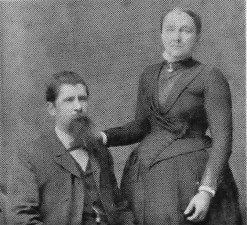
Jesse and Rosannah Newell
This photograph of Jesse Newell and his wife Rosannah was published in a centennial booklet, The First Hundred Years of Jefferson County Kansas, in 1955.

The standard bio for Jesse Newell, found in the local 19th century newspapers and abbreviated county histories, is that he and his brother-in-law Joseph Fitzsimmons co-founded Oskaloosa, arriving from Iowa in 1856. We know that Newell, who set up a steam-operated saw mill, was in the thick of Jefferson County’s proslavery vs. free-state conflicts in September 1856. He is listed in censuses as a physician. He was a Methodist, and came to Kansas Territory from Iowa with Methodist Episcopalian minister’s credentials. He was viewed as a radical freestater.[5] But these synopses say nothing of his Jayhawker or off-the-books Civil War service.

Story No. 2:  Noble-hearted

The Civil War Battle of Wilson’s Creek (read about it here), fought near Springfield, Missouri, was significant for Kansas, which had just become a state on Jan. 29, 1861. It was the first major battle fought west of the Mississippi, and it was one the Union lost to the Confederates. Kansas had quickly raised the 1st Kansas Infantry and 2nd Kansas Infantry regiments, and sent them into the battle Aug. 10, 1861. Jesse Newell had two sons in the 2nd Kansas, Robert and Abram. Robert was killed that day and Abram injured.

Kansas U.S. Sen.  Samuel Clarke Pomeroy spoke of the Battle of Wilson’s Creek that December on the U.S. Senate floor, recounting the work of Kansas soldiers in the young war and lamenting the death of Gen. Nathaniel Lyon, a Kansas freestater favorite who died in the battle. A portion of his address, published in The Weekly Atchison Champion on Jan. 4, 1862, mentioned Lieut. Robert Newell, and his father, Jesse Newell (who was closer to 50 years old, instead of 60 as recalled by Pomeroy).

“But this day’s work was not ended until from the sixteen hundred who went into that battle from Kansas, five hundred and forty men, the pride and hope of our young State, not yet a year old, lay among the dead or the wounded.”  And, continuing…

“Lieutenant Newell, I am sorry to say, was killed. I remember him and his noble-hearted father (though sixty years of age) marching, camping and fighting with us through the long and wasting years of 1855 and 1856, never to be forgotten in our early history.”

Story No. 3:  Too much fight in the material of his constitution

James B. Shaw was a Methodist Episcopalian preacher who came to Kansas Territory in 1857 and was a leader in establishing the church in the new circuit. He knew the developing towns of Kansas Territory and helped install Methodist churches and travelling ministers for the local worshippers. As a result, he knew Oskaloosa and Jesse Newell, and had this to say:[6]

“The town was commenced by members of the church from Iowa. The leading man was a local preacher, and under his leadership they prospered for a time; but there was too much fight in the material of his constitution for these troublous times; so he quit preaching, engaged in the struggle, and was carried away in the excitement; got out of the church and became intemperate. He has once of twice been reclaimed, and the last I heard of him, he was preaching for the United Brethren. May he have strength to triumph over all sin and stand entire at last.”

No, Rev. Shaw does not offer a name for the person above. I’ve narrowed it down to Jesse Newell and Jacob Boucher, another Iowa settler who came to Oskaloosa, Jefferson County, as they were the only two people Shaw could have meant.  I haven’t found much information about Boucher during Bleeding Kansas days or about his leaving the Methodist church.

But Jesse Newell in 1857 formally and voluntarily gave up his Methodist preaching credentials during the “Kansas troubles.”[7] He requested and received  their reinstatement in 1868. The Rev. Shaw also had this to say of Jesse Newell:

 “Jesse Newell was one of the town proprietors. He came here a local preacher; he was ardent and positive in his temperament, and when he went right, he went with railroad speed; but when he stopped, he would not go at all; and when he took the wrong shoot, he went with accelerated motion. I believe on the whole, he wanted to be good, and do good. He had some ups and downs. We hope, through grace, he will get to heaven at last.”

Maybe Newell was associated with more than one Underground Railroad venture, as a guard or escort, and that’s why he had a rifle company. The  passage of enslaved people seeking safety and freedom, after all, was still illegal in 1859 when we meet Newell’s rifle company. Escorts would connect with the network of countryside safe harbor points that extended all the way into Canada.

Recall, too, that Newell and other Jefferson County freestaters had been under assault in earlier years by proslavers from within and without Kansas Territory. Maybe this rifle company remained as a defensive troop for the occasional flare up. It was 1859 and while Kansas Territory appeared to be in the clear to enter the Union as a free state (no slavery), statehood was still a year and a half away and tussles were not unheard of. It wasn’t time yet for a rifle company to serve in a state-ordained militia or in a home guard to ward off Rebels in the Civil War.

A few dark, nameless, conspiratorial stories pop up here and there hinting that Oskaloosa was a headquarters for Jayhawkers during the Civil War. Those accounts cast Jayhawkers as wholly criminal, never noting that the Kansas armed forces officially put Jayhawkers to work saving Kansas from being overtaken by Missouri confederates during the Civil War or taking supplies from Rebels to feed and outfit Union troops. Some of those accounts were written by people associated with spreading slavery to Kansas.

Story No. 4: Physician

This final anecdote, for now, is about Jesse Newell’s status as a pioneer doctor. Censuses listed him as a physician and I have found just one anecdote to back that up. I present the clip from the Oskaloosa newspaper with a warning to the squeamish.[8]

“Tumor Extracted. – Dr. Newell has shown us a small encysted tumor which he extracted from the head of Mr. J. Downing, of this place.  In shape, it somewhat resembled an eye-tooth, and under the glass exhibited the porous characteristics of the skin in a diseased condition.  It was a tough, gristly or cartilaginous substance, and when first removed contained living animalcule of the largest size.  It was extracted by medicine without the aid of surgeon’s instruments.”

[1] You can read about John Doy’s 1859 failed attempt to help 13 freedom-seekers via the Underground Railroad and Doy’s subsequent rescue from a Missouri jail in Abbott’s account here and here.  The unrealized role of  Jesse Newell and other Jefferson County, Kansas Territory, men for the January 1859 Underground Railroad trip is explained here in Part IV

[2] Maj. James B. Abbott  read his story of “The Immortal Ten” rescue of John Doy on Jan. 15, 1889, at the annual meeting of the Kansas State Historical Society, 30 years after the 10 Lawrence area men sprang John Doy from the St. Joseph, Missouri, jail. Future posts will tell a little about those other members of Captain Newell’s rifle company.

[3] The word “Jayhawker” has a lot of connotations. A short explanation can be found here, although  countless books and articles have debated whether Jayhawkers were good soldiers for the cause and defenders of freedom  or merely ruffian thieves.

[4] Jefferson County property tax records, patents filed with the U.S. Bureau of Land Management’s General Land office records and Thompson’s Missouri probate records (ancestry.com) all confirm his land holdings in Jefferson County, Kansas.

[5] Radical freestaters, or Radical Republicans,.opposed slavery in the United States. In Kansas, they also believed African-Americans should be allowed to live free in Kansas, and have rights equal to white men’s. Radical freestaters differed from another sort  of freestaters, those who didn’t want slavery in Kansas but who wanted to bar free African-Americans from Kansas. Jesse Newell was called a radical freestater  by John Day, a fellow Bleeding Kansas-era freestater  in Jefferson County Kansas Territory, in Topeka’s The Daily Commonwealth newspaper, March 15, 1881.

[6] Both quotations are from James B. Shaw’s book, Early Reminiscences of Pioneer Life in Kansas, Haskell printing Co., 1886.

[7] Jesse Newell’s original “parchment” certificate is dated 1853 and is from Oskaloosa, Iowa.  The document  named Newell a deacon qualified to administer baptisms, marriages and burials in certain conditions and to preach the gospel. It is held in the Kansas United Methodist Archives at Baker University in Baldwin, Kansas. The archives also document Newell surrendering his credentials in April 1857  and having them restored in March 1868.

[8] The article, “Tumor Extracted,” was published in The Oskaloosa Independent on July 11, 1863.A

An Underground Railroad Ambush in Jefferson Co. Kansas Territory, Part IV

In 1859 America, it was a crime to help a person escape enslavement. Even if you lived in a state like Massachusetts or Iowa, which prohibited slavery, it was legal for slave owners to come to your state and take back slaves.

Riding as a guard or escort for an Underground Railroad “train” of freedom-seekers was illegal. Operating as a conductor, an organizer or as someone providing food and hidden shelter for fugitive slaves at an Underground Railroad stop was illegal. Federal authorities could charge you with aiding a fugitive slave’s escape, all under the expanded Fugitive Slave Law of 1850.*  Even refusing to help federal officers capture fugitive slaves was illegal.

Secrecy about Underground Railroad routes, dates and people engaged in the perilous enterprise was vital to help ensure that slaves and free black people – sometimes abducted and sold into slavery –would make it to freedom and keep operations alive.

The catastrophic Kansas Territory ambush of Dr. John Doy’s Underground Railroad trek on Jan. 25, 1859, sent 13 freedom-seekers to Missouri, a slave state, and landed Dr. Doy in a Missouri jail. It also revealed   a secret UGRR route and exposed the names of nearly a dozen men who had agreed to help in a dangerous and illegal mission.

Before the night of the ambush, Dr. Doy had conducted a sort of dry run to map out his planned transport of black passengers and to confirm those who would help him along the way.[i]  From Lawrence, in Douglas County, Dr. Doy’s route included stops at Oskaloosa and Grasshopper  Falls[ii] in Jefferson County and  Holton and New Brighton in Calhoun County.[iii]

St Joseph Weekly West June 26, 1859 Doy Waybill
Clipping from the St. Joseph Weekly West (newspaper), June 26, 1859, page 2, column 6. Image from the State Historical Society of Missouri

From his advance trip, Dr. Doy jotted down notes about the best route to take, what expenses he had, sights along the way and the names of men who agreed to help in this Underground Railroad plan. His first stop would be Oskaloosa where he would pick up a guard[iv] to protect the group on the way forward.[v]

Dr. Doy carried his journal notes along with him when he set off that January night with his son, Charles, and a young wagon driver, Wilbur Clough, and the 13 passengers.

Bad move. Post ambush, the notes were snapped up and used as evidence in the Missouri trial[vi] against Dr. Doy for slave abduction. (Dr. Doy was accused of going into Missouri and taking a slave or slaves back to Kansas. Dr. Doy’s defense team argued that he had not been in Missouri when the slaves left.)

Worse, an excerpt from Dr. Doy’s  journal was published  in at least one Missouri newspaper, exposing the names of Kansas Territory men who were willing to participate in the Underground Railroad and break federal law.

To us, 158 years later, Dr. Doy’s notes also reveal  the names of Jefferson and Jackson County people willing to risk themselves to knock down slavery.  In Jefferson County, where legends of Underground Railroad activity carried few facts, we had names to study.  Remember, too, that in 1859, Kansas Territory was not yet a state, although recent elections made clear Kansas was headed toward entering the Union as a free state. The names of  men willing to risk jail and fines to help fugitive slaves and free black people would be of keen interest to their agitated proslavery neighbors.

I’ve taken the journal names as they were published in the St. Joseph newspaper article (left) about Dr. Doy’s trial and attempted to identify them. My sources included census data, material from ancestry.com, various Kansas biographies, material from local historical societies, military records and family stories to try to identify these men.  I do not know who would have transcribed Dr. Doy’s journal for the court or the St. Joseph Weekly West, but transcription errors are likely, as are possible name spellings errors on Dr. Doy’s part.

In Jefferson County, Dr. Doy’s first stop was to be at the home of “Mr. Newall, who (l)aid out  town” of Oskaloosa.  That would be Jesse Newell, an Ohio man who came to Kansas Territory from Iowa in 1856, and co-founded with Joseph Fitzsimmons, Oskaloosa, Kansas Territory. He was a freestater, later described as a Jayhawker and radical Republican, involved in  1856 free-state forces and in Civil War militias.  We hear of Jesse Newell again when Dr. Doy is busted out of the Missouri jail by Lawrence area men (future blog post).

“Mr. Barnes, from Ohio,” on Dr. Doy’s Oskaloosa list, is a puzzle, since there were several Barneses in or near Oskaloosa at the time. My guess is Mr. Barnes was Ebenezer James Barnes, born in 1828 in Ohio and associated with Oskaloosa’s other co-founder Joseph Fitzsimmons.  Eb Barnes had lived in Harrison Township, Mahaska County, Iowa, in the 1850s where Jesse Newell lived, although Mr. Barnes arrived in Kansas Territory later, in 1858. During the Civil War he was captain of Co. E in the Kansas 5th Cavalry, one of Kansas Sen. James H. Lane’s units. After the Civil War, Eb Barnes remained in Arkansas and died there in 1867.  Mr. Barnes’ brother, William Conwell Barnes, is a possibility for “Mr. Barnes, from Ohio.”  In addition, Jared Pierpont Barnes, who lived at Rock Creek in western Jefferson County,  was said to have been involved in the Underground Railroad.  A New York stater, he moved to Kansas Territory in 1857. His home might have been closer to the “Lane Trail,” an UGRR route that went north from Topeka through Jackson County to Holton and to Nebraska. Going to his home would have been out of the way for Dr. Doy, who doesn’t mention going that direction in his notes.

“Mr. W.A. Corwin and J. H. Elliott, from Ohio,” in the Grasshopper Falls (now Valley Falls) area, are difficult to pin down, as well. There were Corwins from New England involved in making Kansas a free state, but not in Valley Falls census records at that time.  My guess is  William A. Cowan and Thomas H. Elliott, both of Pennsylvania  and who arrived in the Valley Falls area in 1855, or one could be Thomas H. Elliott’s father, John Elliott. Both free-staters, William A. Cowan and Thomas H. Elliott later moved on to California.

“Rev. Mr. Moffer,” Valley Falls, was Rev. Josiah B. McAfeeAn obituary details his Kansas life. He arrived in Kansas Territory in 1855, alighting in Leavenworth.  Pressure from the proslavers led to his move to Grasshopper Falls, where he set up the first permanent Lutheran church in Kansas. His (Union) Civil War service included being chaplain of a Kansas colored regiment. He served various state offices and was a prohibition proponent.  Like Mr. Newell, Rev. McAfee enters the picture again after Dr. Doy was rescued from jail.

In Calhoun County, now Jackson County,  “… a fine specimen of a man… Capt. Creitz… who brought his company two separate times to the aid of Lawrence… “ William F. Creitz was an early settler and free-state fighter in Calhoun County, renamed Jackson County in February 1859. He was captain of Co. A in the Kansas 5th Cavalry and an Underground Railroad participant on other occasions. His account of John Brown’s  Battle of the Spurs is a lively read. He later moved to Oregon.

“… we selected Mr. Parks, his companion… “ Most likely this man was Ephraim Markley Parks, another Ohio man who came to Kansas via Iowa.  By 1875 he was living in Oregon.

“Obtained the name of Mr. Wimmery and Martin Anderson, agents for New Brighton…” Mr. Wimmery Likely was Jason Whinery, from an Ohio Quaker family and a Holton subscriber to the Anti-slavery Bugle newspaper from Lisbon, Ohio. Jason Whinery owned land in Jefferson County, as well, near Valley Falls. He later moved to Washington state.  Martin Anderson was Maj. George Martin Anderson, an Ohio man who also came to Kansas Territory by way of Iowa. He was an officer in the Kansas 11th Cavalry who eventually moved to Topeka, Kansas, and served as state treasurer. In the earlier Kansas Territory days, Anderson was supposed to have been part owner of a mill in Jefferson County  where Thomas H. Elliott worked.

“The member’s name in the Legislature is Golden Silvers…” OK, who could mistake the name, Golden Silvers?  When Kansas Territory became a state in 1861, Mr. Silvers and George Martin Anderson served in the first state legislature, representing Jackson County.  In 1863, after Quantrill’s raiders devastated Lawrence, Mr. Silvers was captain of a western Jefferson County Civil War militia cavalry. As a legislator, Silvers was the man who got the county name changed from its proslavery “Calhoun” to Jackson. He was born in Missouri and remained in Kansas, moving one county south to Shawnee County.

[i][i] John Doy, The Narrative of John Doy, of Lawrence, Kansas, “A Plain, Unvarnished tale” (New York: Thomas Holman, Book and Job Printer, Corner Central and White Sts., 1860) 23.

*Just allow me to note here that the provisions of the Fugitive Slave Law allowed slavery’s applauders to harp on about the wild and fanatical law-breakers who abducted their slaves or otherwise helped slaves escape slavery. They didn’t want free states to be able to keep their runaway slaves from them. Free states were unsuccessful in passing their own laws to block slave-hunters (and the Fugitive Slave law) from capturing former slaves in free states. They  saw that law as forcing slavery on them, a violation of states’ rights. Seceding southern states in the Civil War would conveniently separate themselves from trampling free states’ rights when they made their hollow argument that they were leaving the Union to preserve their states’ rights.

[ii] Now Valley Falls.

[iii] New Brighton is now Circleville. Calhoun County was renamed Jackson County in February 1859.

[iv] John Doy did not have an escort or guard to protect the group. He wanted one, but none other than John Brown was arranging a separate UGRR trip for the same time and John Brown got the guard. Brown’s trip was eventful, as well, but his was successful and is known as The Battle of the Spurs. https://www.kshs.org/publicat/khc/1919_1922_lowell_spurs.pdf

[v] John Doy, The Narrative of John Doy, of Lawrence, Kansas, “A Plain, Unvarnished tale” (New York: Thomas Holman, Book and Job Printer, Corner Central and White Sts., 1860) 105,  123.

[vi] A brief description of the trial may be found here: https://www.kshs.org/teachers/read_kansas/pdfs/m12card03bw.pdf


North of the Kansas River: The Battle of Hickory Point

Battle of Hickory Point, Jefferson County, Kansas Territory, 1856

As battles go, this one wasn’t all that big. “Skirmish” comes to mind as a description for the two-day pre-Civil War fight that found early Jefferson County settlers armed and facing off at a little trading post on the prairie.  The heart of the issue was slavery, although participants might have seen a more immediate cause of self-defense or retaliation for the “outrages and depredations” going on in this part of Bleeding Kansas.  And, in all truth, a lot of the combatants in the Sept. 13-14 fight were not from Jefferson County, or even from Kansas Territory. More on that, and all the rest, later in this blog. Continue reading “North of the Kansas River: The Battle of Hickory Point”

About This Blog

I was trying to find something out – anything, really – about Jesse Newell, an Ohio-born free-stater who came to Kansas Territory in May 1856.  He and his brother-in-law, Joseph Fitzsimmons, a Pennsylvanian, had settled on the Jefferson County hilltop the two would develop into Oskaloosa.

They landed in Bleeding Kansas, a long couple of years when the territory agitated over whether it would become a state allowing or barring slavery (the latter, 1861). Newell and Fitzsimmons, moving to KT from the free state of Iowa, positioned their town-to-be right next to an already mapped proslavery town site called Jacksonville, which in the end became a farm and not a town.

Sectional Map of the Territory of Kansas. Published by John Halsall in 1857.
Jefferson County, Kansas Territory, as published in 1857. Sectional Map of the Territory of Kansas, published by John Halsall.

From that point in spring 1856, according to our aged town and county history writings, Fitzsimmons set up a store. Newell set up a steam sawmill. There was something about Newell being nearly hung by proslavery Border Ruffians that year, and about Newell telling free-state[1] troops where to find a bevy of armed South Carolinians who had come to Kansas Territory to make it a slave state. There’s one  mention of Newell being a “radical” free-stater. What else did we know?  Not much.

“We are just one generation away from not knowing our own story.”

That is a warning that had every appearance of having come true, in the case of Newell, and maybe for bits of Jefferson County’s early story. Deanell Tacha,[2] founding chair of Freedom’s Frontier National Heritage Area, made that statement in the early years of Freedom’s Frontier, which has helped communities and organizations tell and connect their stories of freedom in Missouri and Kansas border counties, Jefferson County, Kansas, among them. (Jefferson County, one of the original 36 Kansas Territory counties, is one county over, about 15 miles from the Missouri border.) Continue reading “About This Blog”